Most people treat a sauna like a massage. Something for a birthday, or the end of a hard month. That’s grand, and you’ll enjoy it. But the people who get the most out of sauna, in the research and on our benches, treat it more like brushing their teeth. Short, regular, part of the week.
This post is for anyone who trains: runners, swimmers, rugby and GAA players, the 6am gym crowd, the tag rugby league on a Tuesday. It covers what the science says about heat after exercise, why frequency matters more than anything else, and how to fit a sauna into a week that’s already full.
Once a week is a treat. Three times is a habit.
The best-known sauna research comes from Kuopio in eastern Finland. Researchers followed 2,315 men aged 42 to 60 for about 20 years, and at the start they asked a simple question: how often do you have a sauna?
Compared with men who went once a week, men who went four to seven times a week had a 63% lower risk of sudden cardiac death and around a 40% lower risk of dying from any cause. Two or three times a week sat in between. The biggest differences came from going more often.
A later study in the same region included women and older adults (1,688 people aged 53 to 74) and found the same pattern: the lowest risk of fatal heart disease was in the group going four to seven times a week.
Two honest caveats. These are observational studies, so they show a link, not proof that the sauna caused it. And Finns who sauna most days may differ from the rest in other ways. But the pattern holds across studies, and it points one way: regular beats occasional.
What heat does after training
Three studies are worth knowing.
Endurance: in a small New Zealand study, six competitive runners sat in a sauna at about 90°C for around 30 minutes straight after training, 12 or 13 times over three weeks. Their plasma volume (the liquid part of the blood) rose by about 7%, and their time to exhaustion on a treadmill rose by 32%. In race terms that’s roughly a 2% faster time trial. A small study, but a big effect, and the same idea has been tested in other forms since.
Fitness and blood pressure: a 2022 randomised trial at the University of Jyväskylä put 47 adults on a standard programme of three 50-minute sessions a week, strength then cardio, for eight weeks. One group added a 15-minute sauna after each session. That group saw bigger gains in fitness, and bigger drops in systolic blood pressure and total cholesterol, than exercise alone.
Soreness: a 2023 study with basketball players found that 20 minutes of sauna after a heavy strength and jumping session meant less muscle soreness, better jump performance the next morning, and no harm to overnight heart rate variability. That study used an infrared sauna, far cooler than ours, so take it as a pointer rather than a promise.
The common thread: heat after training gives the body a second, gentler stress to adapt to. The heart works a bit harder, blood vessels open up, blood volume rises. None of it adds any pounding to your legs.
The long game
The Kuopio team also looked at memory. Over 20 years, men who had a sauna four to seven times a week were 66% less likely to be diagnosed with dementia than men who went once a week. Again, a link rather than proof. The researchers point to heart health, and to the plain fact that sauna is relaxing.
Nobody should take up sauna to dodge dementia. But if you’re choosing habits that might pay off in your seventies, this one is pleasant, social and takes under an hour.
Why the room matters
Heat rises. In any sauna the air at the ceiling is far hotter than the air at the floor, and sauna builders measure gaps of 50°C or more between the two. Where you sit decides what you feel.
The Finns have a rule for this, written down by Sakari Pälsi in 1961 and sometimes called the first law of löyly: your feet should be at or above the top of the stones. Sit that high and your whole body is in the hot air, and when water hits the stones the steam (the löyly) rolls down over you from head to toe. Sit too low and you get the classic complaint: hot head, cold feet.
That’s the main criticism sauna specialists make of barrel saunas, the round ones you see in back gardens. They heat quickly and suit a small space, but in many of them the bench is low and the roof curves in, so there’s little room to sit high. Specialists like to point out that you rarely see a barrel sauna in Finland itself.
For recovery, this matters. If your legs are what’s sore, you want your legs in the heat, not resting on a cool floor.
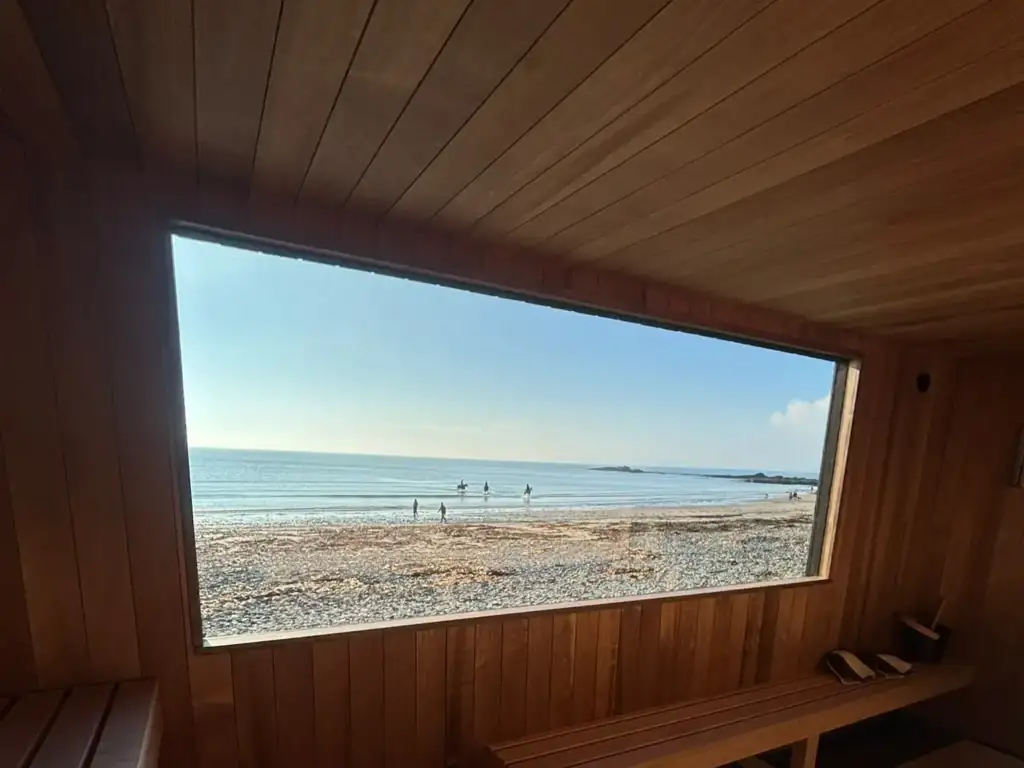
Here’s how ours is built. The Beacon is a cabin, not a barrel: straight walls, a flat ceiling and two levels of bench, with an L-shaped top bench running along two walls. Sit up top for the full heat, or on the lower bench for something gentler. With the stove running at 80 to 110°C depending on the crowd, the top bench is where tired legs want to be. And there’s a picture window onto Garrylucas, which no amount of science can improve on.
Fitting sauna into your recovery week
You don’t need a protocol. You need a slot you’ll keep.
- How often: two or three times a week is a realistic target for most people, and it’s where the studies start to show a difference.
- When: after training, the same day if you can. Weekday sessions start at 5pm, which suits an after-work run or a club session. Weekend mornings suit the long run or the Saturday match.
- How long: two or three rounds of 8 to 15 minutes, with a cool-down between. A 55-minute session leaves room for that.
- The sea: a dip between rounds is your choice. If building muscle is the goal, keep the cold short or skip it after strength sessions, as some studies suggest regular cold straight after lifting can slow gains in muscle size.
- Water: drink before and after. You lose more than you think.
- Not before a big session: heat takes it out of you. Save it for after, or a rest day.
- Listen to your body: if you feel light-headed, step out, sit near the door and cool down slowly.
A simple week for someone training three or four times:
- Tuesday: club training or a run, then a 5pm or 6pm session on the way home.
- Thursday: gym, then sauna.
- Saturday or Sunday: long run, match or swim, then a morning session.
Who should check first
Sauna suits most healthy adults, but not everyone. Don’t use the sauna if you’re pregnant, have been drinking, or are unwell. If you have a heart condition, high or low blood pressure, diabetes or epilepsy, or take medication you’re unsure about, talk to your GP first. Over 18s only.
Make it a commitment
The research keeps saying the same thing: the benefit is in the habit. That’s why our membership is built around one or two sessions a week: Weekly is €50 a month for four sessions, Twice Weekly is €90 for eight, and extra sessions are €12. It runs month to month, with no joining fee and no contract. It turns sauna from something you book for a birthday into something you do on a Tuesday.
See the membership · Book a session
Sources
- Laukkanen T et al. (2015), sauna frequency and cardiovascular and all-cause mortality, JAMA Internal Medicine. University of Eastern Finland release
- Laukkanen T et al. (2018), men and women aged 53 to 74. Healio summary
- Laukkanen T et al. (2017), sauna bathing and dementia, Age and Ageing. Abstract
- Scoon G et al. (2007), post-exercise sauna and endurance in runners. PubMed
- Lee E et al. (2022), exercise plus sauna, randomised trial. Full text
- Ahokas E et al. (2023), post-exercise sauna and recovery in basketball players. Abstract
- Bench height and the first law of löyly. Haven of Heat
- Barrel saunas, the expert view. Spa World